

Join us on the road ahead
We’re committed to helping businesses thrive in a low-carbon economy. Let’s partner in a cleaner future without compromise.
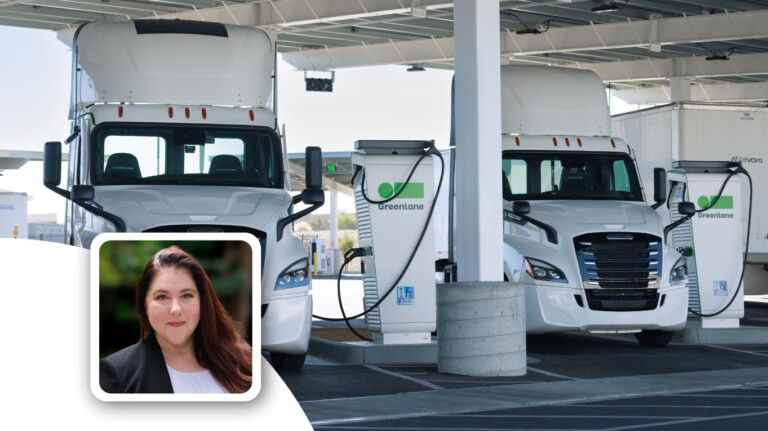
Author: Joshua Koppenjan – Director, Customer Operations
For medium and heavy-duty electric vehicle fleets, time is money, and charging downtime is a direct hit to the bottom line. Unlike passenger cars, commercial electric trucks and buses, with their massive battery packs, require highly strategic charging to keep operations running smoothly.
The single most critical factor influencing how quickly your commercial EV will charge is its State of Charge (SoC), or how full the battery is. Understanding the relationship between SoC and charging speed is essential for fleet and operations managers looking to optimize routes, reduce costs, and maximize vehicle uptime.
A common misconception is that plugging into a high-powered charger guarantees a high-powered charge rate. In reality, the Battery Management System (BMS) within the EV itself dictates the charging speed (in kilowatts, or kW), communicating its limits to the charging station.
This system is designed to protect the battery from damage and prolong its lifespan. It’s why you see charging rates, even on the most powerful DC Fast Chargers, change throughout a session, a phenomenon known as the charging curve.
Electric truck batteries charge fastest when they are near empty and slow down significantly as they approach full capacity. This behavior is intentional. Imagine trying to board an empty bus: it’s quick and easy to find a seat. As the bus fills up, finding the last few empty seats takes much more time and maneuvering. Electrons behave similarly at a molecular level within the battery cells.
For small-duty consumer EVs, the efficiency sweet spot tends to sit between 20% to 80% SoC. However, it differs slightly with medium and heavy-duty commercial EVs. Having worked with multiple kinds of OEMs using high-powered chargers at our Colton charging site, I’ve observed the peak efficiency range can typically be extended up to 95%. Some vehicle models will begin to taper as early as 80%, but the major inefficiency drop tends to occur closer to the 95%mark.
Training semi drivers to target this 20-95% window ensures minimal downtime and maximizes throughput at high-powered chargers.
The size and duty cycle of a commercial EV fleet necessitate a mix of charging levels. For heavy-duty operations, DC Fast Charging is critical, but slower options still play an important role.
While the State of Charge is the primary control, commercial charging performance is a negotiation involving several other elements:
By making the State of Charge the central pillar of your charging strategy, you can transform charging from a necessary delay into a predictable, optimized part of your commercial EV operations.
As a leader in high-performance charging infrastructure, we design and operate solutions built specifically for the demands of medium- and heavy-duty electric trucks. We offer charging reliability for all route profiles, from regional short-haul operations covering drayage and port-side logistics, to strategic fast-charging along major long-haul freight corridors.
If your fleet is ready to implement a data-driven charging strategy that maximizes vehicle uptime and minimizes Total Cost of Ownership, we invite you to contact us.
We’re committed to helping businesses thrive in a low-carbon economy. Let’s partner in a cleaner future without compromise.