
Join us on the road ahead
We’re committed to helping businesses thrive in a low-carbon economy. Let’s partner in a cleaner future without compromise.
Author: Raj Jhaveri – CTO
At Greenlane, we’ve always believed that the right partnerships make progress possible. When it came time to identify a technology partner capable of helping us push the boundaries of public heavy-duty charging, we knew we needed more than a vendor. We needed a collaborator who shared our vision for megawatt-scale reliability, safety, and innovation and chose to work with ABB, a leader in the electrification and automation space.
This article, co-written with Amber Putignano from ABB, highlights how Greenlane and ABB are working together to electrify medium- and heavy-duty fleets from concept to reality — starting with our flagship site in Colton, California. From advanced SCADA and microgrid controls to future-ready electrical infrastructure, our partnership demonstrates what it takes to design charging sites that meet today’s operational needs while preparing for the megawatt future.
Heavy trucks make up around 10% of all vehicles on US roads – but cause an estimated 25% of CO2 emissions and 45% of NOx emissions. In response, more than 400 large US companies including PepsiCo and Amazon have committed to expanding their electric vehicle fleets. However, these large zero-emission vehicles (ZEVs) have unique charging needs that are not being met due to lack of public charging infrastructure for all use-cases, particularly long hauls.
By 2030, an estimated 700,000 EV chargers will be needed to support a projected one million Class 4-8 ZEVs on US roads. According to the latest BloombergNEF Electric Vehicle Outlook (June 2025), the number of MHD truck sales reaches over 827K globally by 2030. All this will require a new generation of charging stations that run at higher power to ensure fast charging.
The most promising – and likely – solution is Megawatt Charging, a near-market technology that promises super-fast performance, but has very high energy needs. To become a reality, facilities based on a Megawatt Charging System (MCS) will need to charge multiple electric trucks at high speed while staying within the limits of the grid.
There are other hurdles to success, such as the need for grid upgrades, a limited number of electric trucks on the road and a still-unproven business case. However, truck developers, utility companies and technology providers are working to overcome these, with the aim of rolling out commercial MCS in two to three years.
Despite its promise, MCS must overcome some hurdles if it is to hit the mainstream.
Firstly, MCS facilities for heavy-duty ZEVs will require significant power, which will put a strain on local electricity grids. This high power is necessary to charge trucks quickly – preferably within a truck driver’s rest period. Each facility will also need to charge multiple vehicles, requiring a charging power that is beyond the scope of current infrastructure. This will all require careful management of peak power – and power fluctuations – to avoid voltage drops, frequency deviations and potential blackouts. Grid stability will need real-time balancing of supply and demand.
Secondly, setting up an MCS site also comes with cost issues that might undermine its potential profitability. Site operators must agree on an energy limit with the local utility company. If they exceed it, the site will automatically be disconnected from the grid. Reconnection, by a utility company technician, usually takes 24 hours or more – a further hit to profits. The utility company can also fine the operator for breaking its limit. In addition, servicing is costly – especially if an operator plans to run more than one site.
The third challenge is one of preparing for the future. Building megawatt charging facilities will be a huge technical challenge. To minimize cost and complexity, sites must be ‘futureproofed’ – by choosing electrical distribution solutions that enable later expansion and capacity increases. Most sites today will launch with EV chargers based on the Combined Charging Standard (CCS) with up to 500kW of power.
However, a new standard for megawatt charging, called SAE J3271, was released in March 2025. This gives a framework for manufacturers of vehicles and charging systems to develop technology for commercial use. Therefore, operators would be well-served to design the electrical distribution infrastructure to support the CCS chargers of today and the MCS chargers of tomorrow.
Additionally, the first generation of MCS systems are expected to be in the 1MW range, while the standard goes up the 3.75MW at 1250VDC and 3000A. Therefore, second and third iterations are expected to be even more powerful, and this should also be considered for future-proofing the electrical distribution for MCS charging.
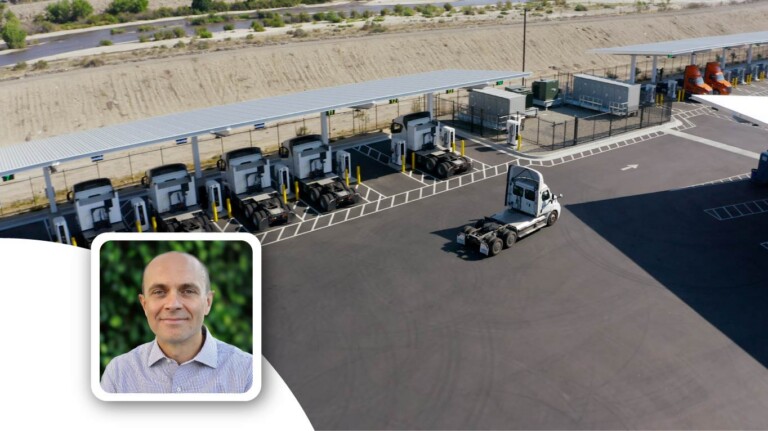
Meanwhile, in the US, we at Greenlane have built a high-speed charging station for electric trucks that will later be scaled up to enable Megawatt Charging. Our site currently has 41 EV chargers, and we plan to scale up to 60, for a combined nameplate charging capacity of nearly 12 MW – enough to charge 600 electric trucks per day.

The site – located in Colton, southern California – plans to upgrade to Megawatt Charging as market needs evolve.
The site’s 41 EV chargers are organized in four groups – each powered by separate 2.5 MVA medium voltage to low voltage transformers. Each transformer feeds a dedicated LV switchboard, which distributes power to each charger in its group. At least two of the switchboards distribute power to charger groups with an aggregate nameplate charging capacity over 2.5 MVA. This increases the utilization potential of the site because chargers rarely operate at maximum capacity – and seldom all the same time.
To achieve all this, we needed to work within the maximum power of each group – and of the overall site. Here, we relied on ABB to help us develop a sophisticated energy management system for Colton. It uses both hardware and software to address three critical areas: grid stability; remote operation and monitoring; and future proofing.
A Supervisory Control and Data Acquisition (SCADA) system with integrated microgrid controls – designed by ABB – underpins many of the Colton operations. The main objective is to ensure that the site operates within the available power from the grid, by balancing charging loads to each truck. This is partly achieved using a technique called load shedding, which prevents automatic disconnection from the grid.
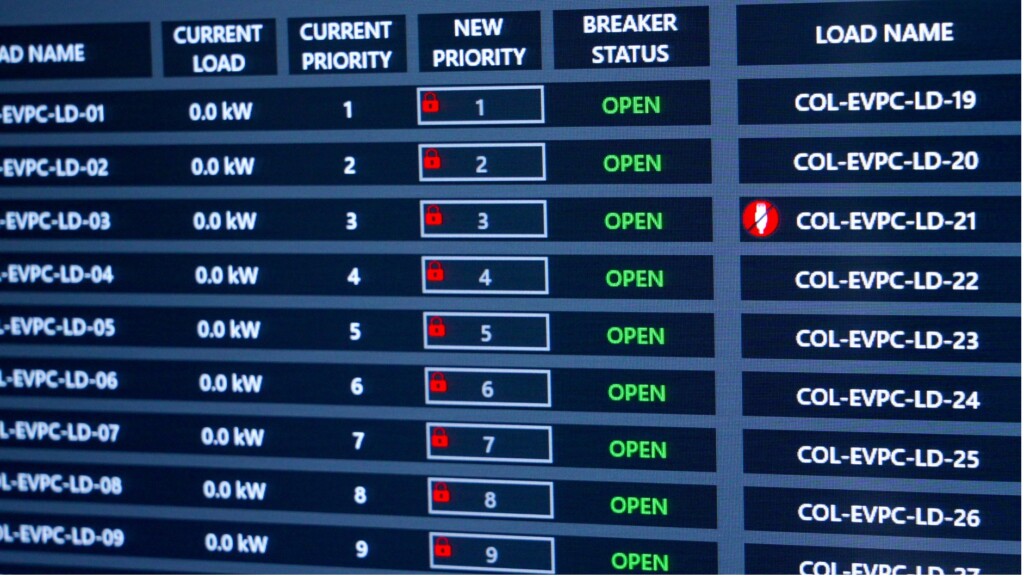
Colton has many levels of load control. The SCADA manages a prioritized load control sequence as a back-up to the Charger Management System (CMS) to ensure that the utility incoming power limits are not exceeded. If the CMS cannot limit charging to this level, the SCADA begins shedding charging loads (when the site reaches 95% of its budget). First, 180kW EV chargers are sequentially disconnected, to minimize disruption across site operations, until power drops below the 95% threshold.
These 180kW EV chargers support long-dwell time use cases and charging can be resumed at a later time to ensure the electric truck has the desired state of charge prior to departure. This should solve any overload problem – or the 400kW EV chargers are next to go sequentially. At 97.5% capacity, the SCADA system targets the MV switchgear – cutting power to the entire site to prevent a full blackout from being initiated by utility controls
The ABB SCADA system will enable Greenlane to make maximum use of power generated from future on-site solar and a Battery Energy Storage System (BESS), as well as take part in Colton Electric Utility’s ‘demand response’ programs. These programs manage local electricity use by encouraging customers to reduce consumption during peak periods. The system can also remotely monitor and control the Colton site for islanding – and supports Greenlane’s future participation in web-based tracking systems to gain renewable energy certificates (RECs).
The first electric vehicles using the site have maximum charge rates of 270-300 kW. If any of them suddenly ended a charging session, it could cause an equivalent – and instant – drop in load. The SCADA must react quickly to these large changes in power, while keeping the power export level within utility restrictions. To achieve this, the ABB microgrid solution incorporates a local site controller – which provides lower latency than a cloud-only solution.
The ABB SCADA solution is paired with ABB’s CogniEN cloud platform, enabling integration of ABB and third-party datasets, such as truck telematics.
When a truck’s telematics data is integrated into Greenlane’s technology ecosystem, the experience can be further elevated through AI-driven management of reservations and energy loads. This minimizes the guesswork for fleet managers in determining the optimal charge time or energy requirements for each route. ABB’s technology helps maximize uptime and operational efficiency by ensuring vehicles are charged efficiently and ready to meet the demands of their freight schedules.
The ABB SCADA and CogniEN cloud platform, combined with appropriate switching hardware, is also critical for remote operation – especially as we create a larger network of similar charging stations in the future. We are planning a series of four sites, including Colton, along a major trucking route – the I-15 highway between Los Angeles and Las Vegas.
The system controls and monitors a series of low-voltage (LV) and medium-voltage (MV) circuit breakers remotely via the CogniEN cloud platform. The ABB solution will also allow control of breakers – and other equipment – across all future Greenlane sites.
ABB’s system is unique in its ability to remotely and safely open and close all LV and MV circuit breakers. This is not typical for EV charging systems today. This feature reduces maintenance costs, enabling Greenlane to perform hard resets on EV Chargers, which can address most software update issues, without dispatching a service truck.
ABB SACE Emax 2 circuit breakers are installed in LV switchboards at the site to provide monitoring and control features needed for integration in the SCADA. The ABB Emax 2 breakers measure instantaneous voltage, current, frequency and power factor with 1% accuracy. Using Modbus, the circuit breakers send information about the power delivered to each EV charger to the SCADA system. This enables Greenlane to collect valuable data and operate the circuit breakers remotely via the ABB CogniEN cloud platform.
We also needed an MV switchgear that fits into the overall ABB solution, allowing remote monitoring and operation.
It needed to be a three-way switch that would allow integration of two separate energy sources for redundancy – when extra capacity is added later by the utility provider. As well as remote monitoring and control, we wanted a durable, low-maintenance solution that could be safely installed and operated close to large moving vehicles. Finally, it needed flexibility for upgrades to accommodate future site expansions.
ABB’s medium voltage Elastimold® Padmount Switchgear met all of these needs. Its bus bars are coated in a solid-dielectric rubber molding, preventing oxidation that can reduce equipment life and cause service outages. The switchgear is nearly maintenance-free because it contains no oil or gas to monitor or maintain – and no fuses to replace.
A safety relay monitors current and activates the trip switch if an overload condition occurs. A Tru-Break™ switchgear module offers visible confirmation to operators that each individual phase of the switch is open before they carry out work.
As a modular solution, Elastimold switchgear allows for future expansion. For instance, it will allow for the addition of extra switches to the cabinet – to support site expansion, or to segregate downstream chargers that will be powered by different energy sources (such as solar).
The overall system is adaptable enough to allow Colton to upgrade to MCS when it becomes available in two to three years – using 1 MW or 1.5 MW charging stations to speed up truck recharging. The aim is to add substantial vehicle range within the mandated 30-minute rest time for drivers in the US – bringing it in line with traditional diesel-powered trucks. Greenlane has also signed up its first commercial customer, Nevoya – an electric-only freight company – which is now operating a fleet of trucks from Colton, with plans to run up to 100 vehicles from the site.
Megawatt Charging promises to drive freight electrification and bring electric trucks into the mainstream. Hurdles to its adoption remain – but the new SAE J3271 standard, rising demand from users and immediate availability of suitable technologies will help accelerate its adoption.
Our goal is to make zero-emission freight more accessible, reliable, and operationally efficient for the trucking industry. If your fleet is exploring electrification, we’d welcome the opportunity to discuss how our sites and technology ecosystem can support your transition.
Connect with us here: www.drivegreenlane.com/contact/
We’re committed to helping businesses thrive in a low-carbon economy. Let’s partner in a cleaner future without compromise.